"One does not discover new lands without consenting to lose sight of the shore for a very long time." -Andre Gide


Showing posts with label Coronado 25. Show all posts

Sunday, October 31, 2010

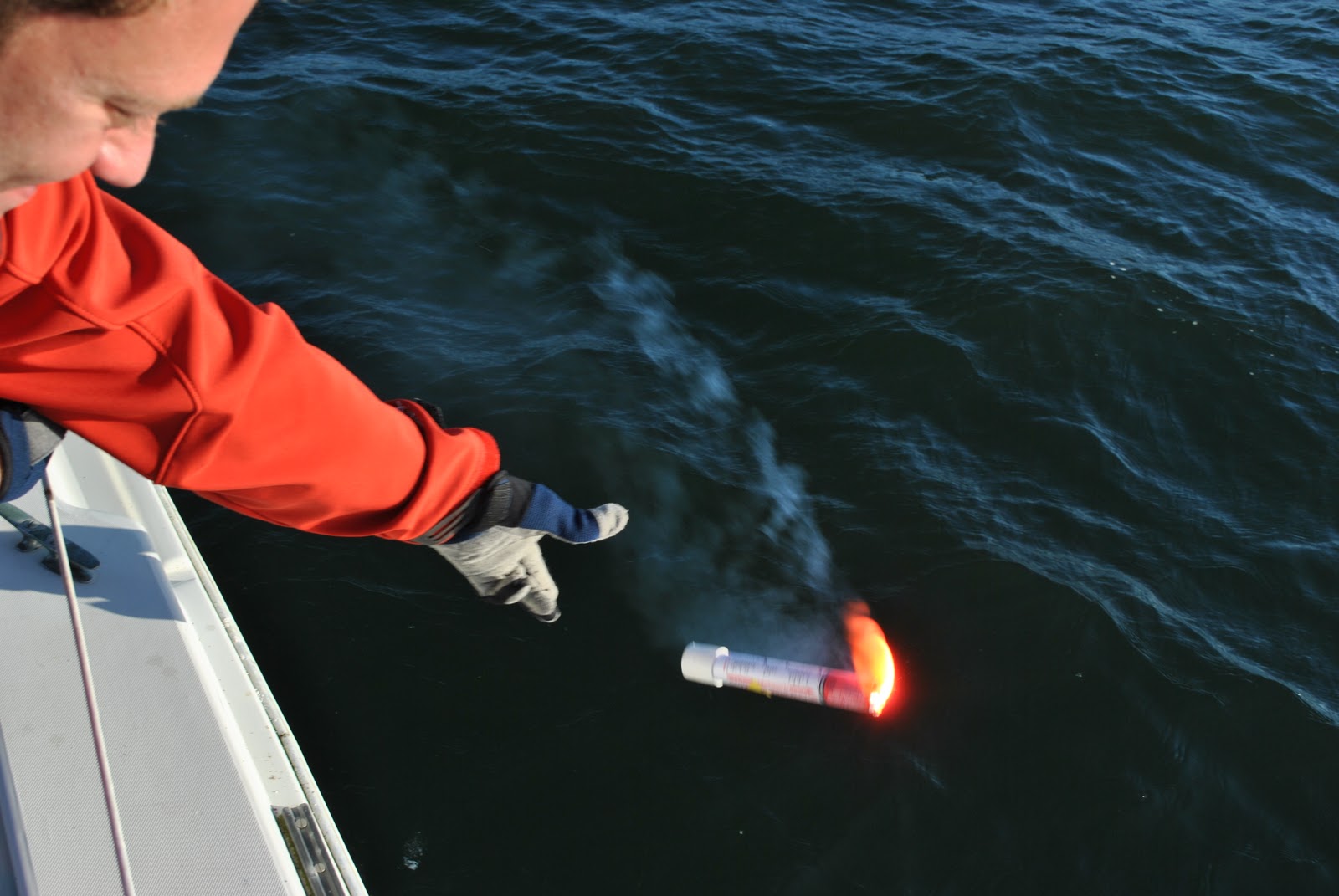
Flares 101

#1 Reason for Failing a Safety Check by the Coast Guard . . .

. . . . having expired flares on board.

All the other items are easy to keep track of.  Lifevests.  Check.  Registration numbers on boat.  Check.  VHF radio working.  Check.  But, everyone forgets to check the expiration date on their flares. 

Which begs the question: What does one do with expired flares?


We'd never lighted a flare before.  But, hey, it was expired!!!!  It seems silly to light a flare when we didn't need any help.  No S.O.S. here.  But, now we know that flares don't burn in water.  They are bright.  They are hot in your hand.  We think that they burn for 13 minutes.  I hope help is closeby if we need it!

Friday, May 21, 2010

Baby Bird Update: 2 Weeks Old

Thank goodness these little guys are growing quick!  Hopefully by next week they will be out of the nest. We are definitely sailing on Memorial Day weekend, so they have a deadline!

Thursday, May 20, 2010

Where to get help about your boat . . . ONLINE

This is a short note on a resource that I have found very helpful in learning the ins-n-outs of Training Wheels.  This resource is Yahoo Groups.

I have had specific questions about my boat that needed to be answered. Luckily, I found a Yahoo Group for Coronado 25 sailboat owners and most of the members are even Coronado 25 owners of my exact boat. This has been a treasure trove of good information on specifics like dealing the original seacock valves or changing the drain tube on the ice box. I have rarely seen any topic not get at least 3 good responses for solutions or support.

http://groups.yahoo.com/group/Coronado25/

Wednesday, April 28, 2010

Sailing in Heavy Weather

I recently received from my netflix queue the video "Sailing in Heavy Weather" from the Better Sailing Series hosted by Mark Schrader. I have watched...actually I tried to watch some other sailing videos on Netflix but never got that far into them before turning them off. Either the sound of the wind howling in the microphone was so loud you couldn't understand the speaking, the video camera pointing one direction would be constantly showing nothing important, or the Miami Vice 80's haircut and outfits would drive me to turn it off. "Sailing in Heavy Weather" was mostly upto date and overall pretty well produced especially concerning the conditions.


There are quite a few good nuggets of information in the video but main points I learned for my beginning skill level is below;
  1. Practice reefing before you need to reef. During a 30 + knot gail is not when you want to be figuring things out.
  2. Practice often. Knowing how to reef is good but knowing how to reef very quicking is even better. It is quite difficult to keep enough slack in the sails by heading up in heavy weather to allow the sail to come down. The tension may only be off the sail for a minute before a wave or wind pushes the boat away from the wind direction putting tension back onto the sail.
  3. There are two ways to handle heavy seas, passively by battoning down the hatches and waiting it out underneath and actively by sailing. Todays modern boat designs generally do better by being actively sailed. After watching the video I still not totally sure what to do in a Coronoda 25. It is not a modern boat but I think I would be more comfortable trying to actively steer the boat but I doubt I could keep it up that long.  
  4. Reef early before the heaviest wind comes then test the balance of the boat to see how it handles. Many Captians get in trouble because they reef down too much and can't control the boat. Find the balance of power and heeling that allows the boat to be steered well by lettling out more cloth.
There was  a section on heaving to in the video that I think was done well but I will go into a deeper discussion on this in a later blog as setting your sails so that you make no very handy thing to be able to do.

Monday, March 29, 2010

Boat to Boat Communication?

The sun was shining, the sky was clear, but the wind was calm at the harbor. Near my favorite surf spot there was a little wind but I still decided not go out sailing yesterday. I didn't want to risk bobbing around for an hour going nowhere like earlier in the week. Then I saw Gracie Ray, a boat I have raced against before, going out. Maybe there is some wind off shore. Great, I can wait for them to get outside the harbor and call them on the VHF to find out the conditions.

Then I realized, I have never called another boat before and have no idea what channel to use. Another research project. Some very basic rules from my online research and talking with other captians:

1. If at all possible, agree on a channel to use with the other boaters before hand.
2. Most folks should have channel 16 on and this can be used to get their attention.
3. An easy example of correct lingo "Training Wheels calling for Gracie Ray".
3. Agree to switch to another channel once this is done, ASAP. Channel 9 is the standard boater comm channel.

Channel 16 is the emergency and distress safety channel monitored by the Coast Guard and they really don't want to hear everyone's conversation.  This is a basic thing but that's what this blog is about. Training Wheels living up to her name.
~Capt

Wednesday, March 24, 2010

The Right Outboard Motor For The Job

Training Wheels originally came with a 6 hp 2 stroke regular shaft outboard that usually pushed the boat along decently. It was loud and smelly but mostly did a good job. The motor had a regular shaft and somewhere along the life of the boat the transom had been built up about an inch higher (more on this later). This meant that the prop didn't always stay in the water. The first few times I took the boat out, I couldn't figure out why every so often the engine would start to sputter or just thrash water around behind the boat. Then I realized that when anyone went to the bow of the boat or in waves the prop would pull out of the water.  This wouldn't do, and so my research for a new motor began.

I wanted to be safe and have as much power as I could to cope with any condition that was thrown at me so I wanted to go big. This was obviously a previous owner's idea as well, as noted by the drag racer scoop that was attached to the hatch of the engine bay lazerette. I assume this was done to allow enough head room to fit a large 75 hp motor. The first thing I found out is that this was comically useless.

1. After a sailboat reaches hull speed, any extra horsepower isn't really going to do you much good and will only serve to waste fuel. Hull speed is hull speed (maximum of 1.34 times the square root of the waterline length) regardless of whether or not the water is moving itself. Hull speed for my C25 is then 6 knots.  What does this mean? I need an engine that can get my boat to 6 knots which is pretty slow. This is a point for a smaller engine. Large HP engines perform really poorly at slow speed like this.

2. What am I going to do with motor? With me, it will be mostly docking and making it out of the harbor to actually sail. This means backing up is every bit as important as moving forward, and slow speed control is key, so a shallow pitch prop (6 inches or less) is used, and a 20" or longer shaft is mandatory to keep the prop in the water if the boat porpoises through waves or when crew move around the boat. In our Coronado steering is done by the boat's rudder, and the outboard is locked in dead-ahead. No room in the lazarette well to turn it. Point two for a smaller motor.

3. Size of your boat. Some advice given was to go as big as you can, as I thought in the begining. The usual example given by powerboaters is stopping power. You're not really able to "stop" a sailboat with your engine, like you do with a powerboat by throwing it into reverse. Especially not an 4500 lbs boat. Because once it gets momentum, it doesn't just stop but only help to slow it down. I've seen sailors with big boats coming up to the dock too fast, then trying to slow down with reverse. And it just doesn't work. When that happens, somebody usually has to jump onto the dock at the last minute and stop the boat with a line on a cleat or pole. Dealers have told me that the 4-strokes have much better low end power (good) than the old 2-strokes and I need one hp per 500 pounds of sailboat. So for my C25 it looks like an 9hp 4 stroke.

4. More hp means more size and weight. I still wanted a bigger engine if I could, and I did investigate 15hp engines. The 9.9hp engines are smaller usually by about 30 pounds (almost 30%), lighter than the 15hp and the price difference is about 10%. The weight is a bigger factor on a saiboat, but for only 10% more, hmm. After reviewing the specs of various 15hps, it would appear that the 15 is not an option. Too big fore-and-aft to fit through the lazarette hatch. So I am now down to picking a 6hp or 9.9hp.

5. Extra features that matter. One thing that is always a concern on a boat is power. 9.9hp outboards are the smallest engines that include electric start and charging of the batteries while in use. This sealed the deal. Now to start the craigslist search.

Winner is a Yamaha 9.9hp 4 stroke long shaft. I found it on craigslist in town for $200. Talked him down easily enough to $150 since it didn't run at the moment. The cylinders had good compression (thumb over the spark plug holes while attempting to start.) but no spark. A trip to the marine mechanic and the engine was up and going for only another $50.

Wednesday, March 17, 2010

Numbers and such for a 1970 Coronado 25 sailboat

Found this information at Sailboatdata.com from the original Coronado 25 sales brochure.  The stats will come in handy for my next post on picking the right outboard motor for your sailboat. I am sure I will also be able to refer to this in the future posts as well. ~Captain


Friday, March 12, 2010

TGIF Sunset BBQ

Thanks to the good Captain, we had planned to take the boat on the Bay for BBQ Filet Mignon, photography, and local Sauvignon Blanc!  I was so grateful to have this evening cruise on the schedule, because it has been a super long busy crazy week!  And, I've been reading The Motion of the Ocean!  This is Janna Cawrse Esarey's book fully entitled: The Motion of the Ocean: 1 Small Boat, 2 Average Lovers, and a Woman's Search for the Meaning of Wife.

So, I had planned to present the B-HAG concept to my Captain: Big Hairy Audacious Goal.  This is Janna and Graeme's grand concept, a'la stimulus package!  Basically, come up with a goal that is bigger than life, create a stategy for accomplishing it, and then throw caution to the wind and take a deep, cleansing breath, and go for it!!!!!!

If you have a big Goal . . . . would you dare even say it out loud? Would you share it with anyone? Would you keep it silent, secret and let it build momentum inside like a 2 Liter bottle of Pop shaken up? What do you think?

TGIF!  We had a wonderful sunset BBQ cruise!


Thursday, March 11, 2010

Sailing Forecasts, or lack there of!

Last week, I wrote about the difficulties I have with finding decent sailing forecasts to help plan or determine if I should go out to sail. Today's sailing adventure was a prime example.

For the first time in a month, the swells have gotten below 10 ft and I was a little exited to get off the surf board and onto the boat. Even though the swell had been tolerable, the winds for the last two days were gusting up to 50 Mph. Way more than I want to deal with!  But always the optimist, I keep thinking any day now it will be perfect. And waking up this morning, I knew today was that day.

The surf forecasts on http://www.surfline.com/ were for 4-5 feet at 12 seconds. Swell is good, now onto wind. http://www.weather.com/ listed the wind at 10-15 Mph.  Bingo, I am on!  But before I left, I decided to look at the bouy reports themselves, it showed a gradualy increasing 12 ft swell at 20 seconds. Not great, but 20 seconds is long enough to make these Pacific rollers a non-issue. I also decided to check a surf spot on the way to the boat and the wind seemed lighter than 10 Mph and waves looked barely 4 ft. Once again, I am stoked and good to go.

So, I am on the boat heading out of the slip and I am calling some bros to come out and experience this perfect day with me. Then I notice the wind seems a lot more than 10 Mph. I would have actually guessed more than 20 Mph. No way this is going to ruin my perfect day!  I needed some practice reefing and handling in stronger winds anyways.  My first view of the harbor mouth is pretty calm but as I get closer I start to see the waves are a little bigger than 4-5. They actually look more like 8 -9 feet. Not perfect but I usually put my limit at 10 feet so I am still good to go.  I decide to get my sails ready before I get out of the breakwater's protection. I unfurl the jib but only to about 40% original size and imediately take off hitting the boat's top speed, so I skip the Main altogether. A gentlemen I met at a bar said he owned a 1969 Coronado 25 and it handled better in heavy wind with Jib alone, so I decided to put it to the test.

Moments later, I have almost reached the breakwater at the harbor entrance and a swell comes in that is bigger than the 8 feet I saw earlier. These were more like 11-12 feet. Morro Bay's harbor is notorious for having large waves in the harbor mouth and they usually calm down about a half mile out. I charge on. The swells are making it slow going and just outside the harbor another set comes through bigger than the last. The first two waves were bit of a rush but the third wave of the set was 16 feet or larger and looked like it was going to crash right on the bow. Not having a lifeline yet, I wraped the jib sheet (rope from the front sail) around my arm, griped the tiller tighter and crouched down bracing for impact while thinking "is this auto-inflat life vest going to blow up if I am hit by a wave?". I hit the bottom of the wave trough and started to climb the wave. Yep about 16 feet, the 25 foot boat easily fit on the face of the wave. (waves are measured from the midline up, so the total face of the wave was about 30 feet.) The wave never broke and I easily made it over. Being by myself I decided to head in and declared my perfect day officially a bust.

What did I learn?  First, I should have checked the NOAA automated reports on the VHF radio, they probably would have given a clearer picture of the actual conditions.  I also needed to pay more attention to the bouy's live feeds than surfline's report which is specifically for near shore predictions.  I knew this, but I really wanted to go so wasn't going to let a bouy rain on my parade.

Next, I need to get a lifeline. A lifeline is just a rope that ties you to somewhere secure on the boat like the mast. It keeps you from going overboard. I had this as a lower priority item on my purchase/project list because I didn't really envision sailing by myself that often. I don't really want to, but I have come to the conclusion that I will solo sail from time to time.

Finally, I need to find a frakk'n better way to get surf forecasts at home so I can avoid these type of let downs. The day was a bust, but at least fitting in the Battlestar Galacticaism means I can end the day with a smile.

Over and out.
~Captain

Tuesday, March 9, 2010

Cabin and Galley

I should really care about his post...because this is my domain.  I know I should be really passionate about the work that we did to the interior.  And here in lies the dilemna.  What do you post when you don't really feel like posting anything? 

It is not really true to the author and not really fair for the reader, but here goes.  I do have some pictures saved up on the galley.  I don't have before pictures, unfortunately.  Just, after pictures.  And a shameless plug for the GREATEST UPHOLSTERY BUSINESS IN THE STATE: Shannon's!

Ok, I do have a before shot of the NASTY OLD MUSTY cushions in the galley.   ewuuhhhhh!
The zippers were rusted out!  I don't even want to know what happened on these cushions in the last 40 years!  NASTY!

So, we looked through about 400 vinyl marine quality samples with Mr. Shannon!  We chose "Cardinal"....any surprise?  Yes, it fits well with the Captain's USC fettish.  Check them out!
We made a new teak table which we high-glossed the same way as the exterior teak.  We also high-glossed the Galley cabinets.  The cutting boards are just wiped down with teak oil.  The faucet is new. 

I like the way it all turned out.  There are some older blue vinyl cushions and the bright cardinal cushions.  All of them wipe clean easily.  The interior is warm.  It is cozy.  Even if I never go on an ocean sail, the boat has enough charm to keep me happy in the dock. 

It has been so rainy lately that we haven't been able to enjoy it.  I miss it.

Sunday, March 7, 2010

The Beautiful Spinnaker Sail!

Ode to the Spinnaker Sail that I do not have enough money to buy . . .

I wish you were Matthew Modine and I was Baby
And I owned a sewing machine in the floor….
Oh, how I would make a spinnaker.
Oh, how colorful she would be.

If anyone can get this slanted reference to a Disney movie called Wind, staring Matthew Modine and the girl called Baby in Dirty Dancing....it was basically a 13 year old girl's trashy romance about saucing sailors and a killer magnifico spinnaker.
 
At any rate, I love the Spinnaker Sail!  It is always bright and cheery and wonderful.  It fills with wind and balloons out in front of the boat.  Can I just say it again: I love spinnaker sails!!! 
 
We saw several spinnakers this weekend.  I realized today that we will probably never have one on Training Wheels.  Flying a spinnaker is for the Big League-er.  We are just not on the level.  It is best flung with the help of a crew; extra hands are needed to fly it and reel it in.

Again, I apologize for not keeping the horizon horizontal.  I need a tripod or level attached to my camera!  I took these with the 55-200 mm lens on RAW setting.
The picture quality broke down even on the RAW setting when I zoomed in to get a close up of the blue spinnaker.  I am still not sure how to best capture these distant events!

Tuesday, March 2, 2010

The Search for Sailing Forecasts

I have had difficulty finding good or even decent sailing forecasts to help in planning out upcoming sailing outings. I am not looking for much, just an easy way to quickly read if the winds are between 3 mph and 20 mph and the swell is under 10 feet at an interval greater that 7 seconds. Is this too much to ask?

Maybe this is a product of the "want-it-now" generation, but I am a little amazed nothing is done on the internet (at least that I have found) for such a generally cash rich pasttime as sailing. For the most part, I have fought the desire to techno-ize my sailing experience.  I prefer "old school" sailing with no electronics on board except for the VHF radio required by the Coast Guard. This traditional Old Man And The Sea stance not only has saved a ton of money, but I hope will give me a firm foundation of all-things-sailing.

The best forecast I have found so far is a prerecorded telephone message done by a gentleman at a nearby power plant. He's actually very good . . . . but how 80's is that?  Online, I sometimes use a mix of http://www.weather.com/ for wind and storm info and http://www.surfline.com/ for swell height and period and sometimes wind that is not always that accurate (especially off-shore).

Saturday, February 27, 2010

Is this El Nino?

So, basically, it has rained 8 out of the last 10 days.  But, we have a spot of sun today!  Hallelujah! I am off to the library to get a few books.  I've got a request queue, but only one book has come in. 

Here is my queue:
How to Photograph Water by Heather Angel
The Sweet Life by Mia King
Islands in the Stream by Ernest Hemingway
It takes Two by Patricia Chen
The Motion of the Ocean: 1 Small Boat, 2 Average Lovers, and a Woman's Search for the Meaning of Wife by Janna Cawrse Esarey

The only one that I expect to pick up today is "How to Photograph Water".  But, hopefully, with all the rain, waves, puddles, etc....I will be able to post some great water shots by the end of the weekend!
 
I will take this opportunity to also explain why we haven't posted many actual sailing pictures.  The reason is because the Captain usually goes out on the ocean by himself or with another mate.  He takes a couple one-handed shots with his iphone...and, waalaa.....


Yes, we will definitely be working on this! 

Wednesday, February 24, 2010

Part II: Leaking Porthole and Portlight fixes that REALLY work!


Supplies:

3-5 sunny days in a row!
Putty knife
Acetone
Plastic shims
Masking tape
3M Marine Adhesive Sealant 5200

Step 1: Remove window.
Break the exterior window seal (ie. old caulk, sealant, gasket, etc.) with metal or plastic putty knife/scraper. Careful with a metal scaper as it can scatch the fiberglass. I ended up with a few scatches but they easily buffed out. Remove screws from galley side of window casing. From the interior, tap window frame with rubber mallet to loosen the seal.

Step 2: Remove old caulk.
Remove all old caulk or sealant from all surfaces, including window and boat hull.
Start with metal or plastic putty knife to get the bulk off and then continue with acetone or other paint thinner.

Step 3: Inspect.
Inspect all surfaces: wood core of boat hull (between the interior and exterior fiberglass layers) for water damage. If not already done, epoxy over any exposed areas. If water damage is found, please address appropriately. Good advice in general but my Coronado 25 is just fiberglass no wood core so I could skip this.

Step 4: Apply generous amount of caulking to window frame.
Insert window frame into the hole in the boat. Place the ¼ inch or smaller shims around the exterior edge of the window frame, between the frame and the hull. I used wood shims on the first window and one broke off with bits of it stuck in the caulk. Plastic worked much better. Tighten down window onto shims making sure there is a gap. The caulk will naturally squeeze out around the edge, but this is good because it creates a new seal. Wipe excess with rag. LET SET for 2 days.

Step 5: Remove shims.
Remove shims and tighten down the screws completely. Allow to SET for 5-7 days.

Friday, February 19, 2010

Part I: Leaking porthole and portlight short-cuts that never work


In a 40 year old boat, leaks are bound to spring up around portlights. Many newer boats even have this problem due to environmental exposure, heat expansion, and flexiblity properties of the material the portlight is constructed of and the fiberglass that it is adhered to.

The first thing I learned during my anti-leak crusade is what many of you maybe thinking, "What is a portlight?" According to http://www.seatalk.info/, a porthole is an opening in a boat that allows light and air to enter a boat. Often a clear glass portlight is attached to the porthole with hinges and can be closed with a gasket to make a waterproof seal. In land lubber terms, if the window opens it is a porthole and if it doesn't as on our Coronado 25 then it is a portlight. Now that we have our terms straight, let's get on to some things that most boat owners try and never work.

The biggest waste of time is slopping on a nice wide stripe of clear caulk over the gap in between window glass and its frame. Other than being a complete waste time, this also looks unsightly as the clear caulk often turns a chaulky, oxidized white with sun exposure. Leaks rarely come from this area because the flexibility and heat expansion of the window and it's frame are usually not that different and the glazing material is well hid from sun exposure making for a very long life and secure bond.

What sometimes works but usually doesn't is applying caulk over the gap between the portlight frame and the hull of the boat. This is where most leaks come from. However, applying caulk over the old caulk or other material used often doesn't work for a couple reasons. Once old caulk has dried, the new caulk doesn't adhere well to the old caulk. Another cause of leakage is that the caulk bridging the gap requires a much greater flexibility tolerance than caulk directly between the two surfaces. All it takes is microscopic gap to cause a capillary effect that will actually draw water into the boat.

The final short cut that rarely works is tightening down the screws or bolts that are securing the clam shell type portlights on most boats. And the reason this usually fails? You guessed it: the boat flexes. Tightening down the frame can sometimes lead to striping of the screws or bolts, but mostly reduces the elasticity of the caulk or other material used to create the seal. Even if it does provide some temporary relief, the first crew person to walk on the deck near the window will break the seal again because the caulk now has reduced tolerance to flexing of the hull.

What did I learn? As I have learned many times before, shortcuts have very little use in sailing and usually just cause more work. Specifically for the portlights, I learned the caulk used to make the water tight seals on the portlights has two main purposes: to adhere to the hull of the boat and portlight creating a water tight seal and to provide a buffer or flex point that allows the fiberglass hull and aluminum or steel frame of the portlight to move in different directions while still keeping the seal.

My next post will go through resealing the portlights the right way!

Saturday, January 30, 2010

Weekend Warriors


Mounted a classic British Seagull motor (spare) on the back.
Ran new rope through the auto-furler.
Ran new rope through the main-sheet.
"Water Bow Line" knot tied.
"Lashing" done to secure rope ends.
Truman ran 10 miles today; I ran a leasurely 5. But, we spent almost all day in the sun! It was glorious!